
Bluetooth® Channel Sounding: Precise, Secure Distance Measurement Finally Comes to Bluetooth LE

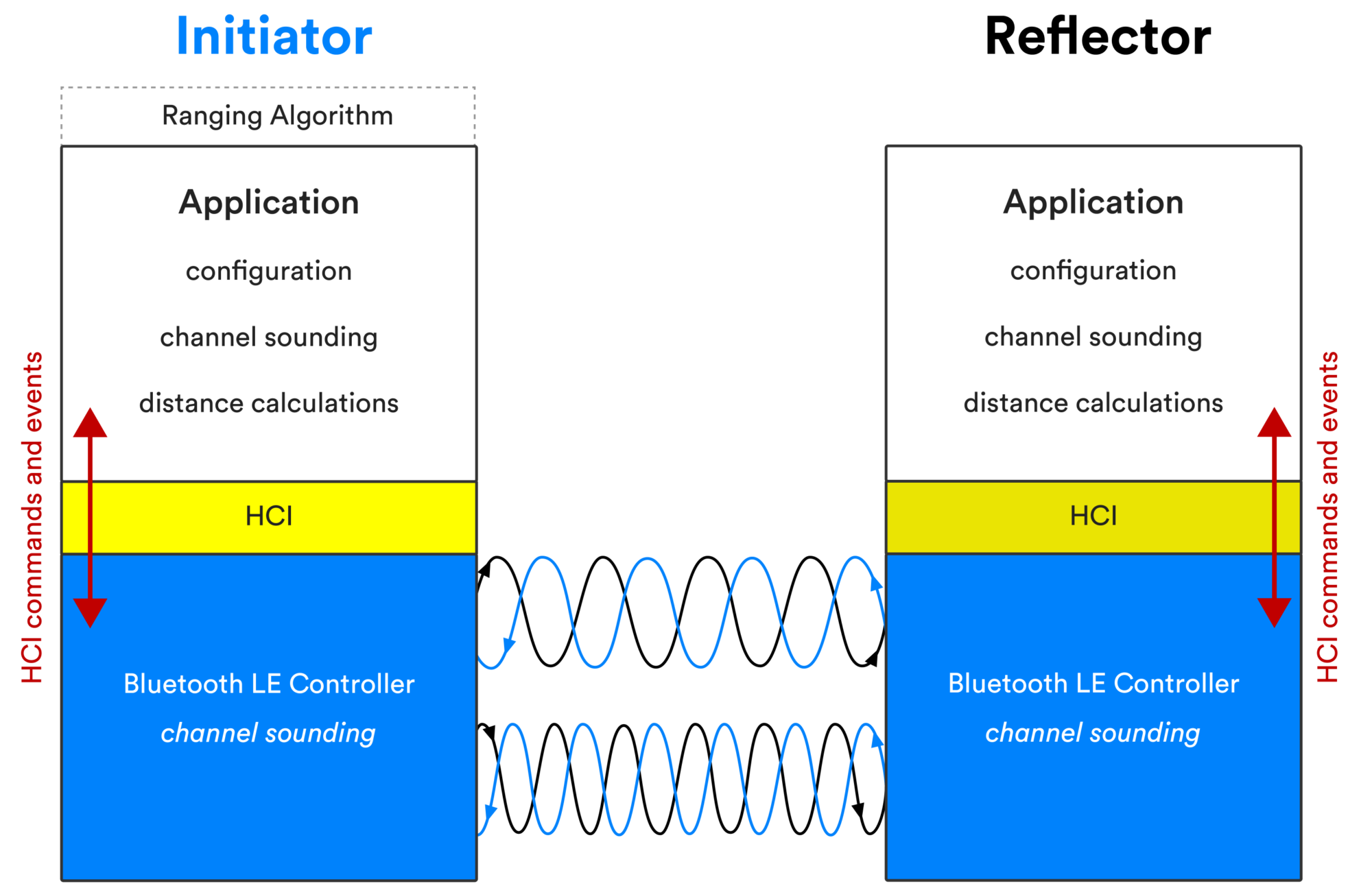
For most of Bluetooth LE's history, answering the question "how far away is that device?" meant one of two unsatisfying answers: RSSI-based ranging, which is notoriously unreliable, or adding a secondary radio like UWB to your BOM. With the introduction of Bluetooth Channel Sounding in Bluetooth Core Specification v6.0, that changes. Bluetooth now has a native fine-ranging capability built into the spec, and it's worth understanding both what it can do and what it means for real product development.
Why RSSI-Based Ranging Was Never Good Enough
To appreciate what Channel Sounding brings, it helps to understand why the previous approach fell short. RSSI-based ranging relies on measuring signal strength at the receiver and working backwards from a known reference level to estimate distance. The physics are straightforward: signal strength attenuates with distance, roughly following an inverse square relationship.
In practice, it rarely behaves that cleanly. Multipath propagation, antenna orientation, RF obstructions, and even the presence of a human body between two devices can cause RSSI measurements to swing by 10 dB or more. At typical indoor ranges, that translates to distance errors measured in meters, not centimeters. For applications like asset tracking in a warehouse or detecting device proximity in a smart building, that imprecision is often manageable. For a digital key system that needs to reliably unlock a car door when you're standing next to it, and not when you're thirty feet away, it is not.
How Channel Sounding Actually Works
Channel Sounding supports two complementary distance measurement methods: Phase-Based Ranging (PBR) and Round-Trip Timing (RTT). In most deployments, PBR does the heavy lifting on distance accuracy, while RTT serves a largely security-focused role.
PBR works by transmitting signals at two or more different frequencies and comparing the phase measurements of the signals received back from the remote device. Because the rate at which phase accumulates over distance is tied to wavelength, and wavelength is tied to frequency, the phase difference between two known frequencies at a measured distance gives you the information needed to calculate that distance. Channel Sounding uses a dedicated channel arrangement of 72 channels spaced 1 MHz apart across the 2.4 GHz ISM band. The tighter channel spacing, compared to the standard 2 MHz Bluetooth LE channel width, extends the range at which PBR calculations remain unambiguous to approximately 150 meters.
RTT takes a completely different approach. It measures the round-trip travel time of a CS_Sync packet exchanged between the two devices. Radio travels at the speed of light, so time-of-flight directly translates to distance. The challenge is precision: at the speed of light, a timing error of a single nanosecond represents about 15 centimeters of distance error. Channel Sounding addresses this through several optional fractional timing methods, including analysis of sounding sequences and random sequences appended to CS_Sync packets, which allow sub-nanosecond timing estimates.
The two methods are designed to be used together. PBR provides the accuracy, RTT provides the security (it is computationally very difficult to simultaneously manipulate both the phase of ranging tones and calculated round-trip times to produce a consistent false distance reading).
Applications That Now Become Practical
Digital key. This is arguably the highest-profile target use case. Passive entry systems for vehicles, hotel rooms, and secure facilities need to distinguish between a user standing at the door and one sitting in a lobby down the hall. RSSI-based ranging has proven exploitable via relay attacks, where a device amplifies and forwards signals to spoof proximity. Channel Sounding's combination of PBR accuracy and RTT-based attack detection directly addresses this vulnerability. The Bluetooth SIG has defined four security levels for Channel Sounding, which future profile specifications are expected to reference for digital key implementations.
Find My. Consumer item trackers are the most visible expression of Bluetooth proximity technology. Today's products can tell you a lost item is "nearby." Channel Sounding enables them to tell you it's two meters to your left. The improvement in user experience for finding items in cluttered environments, bags, or behind furniture is meaningful.
Industrial asset tracking. Warehouse and manufacturing environments have long used Bluetooth beacons for zone-level asset location, accepting that "somewhere in bay 4" was the best available answer. Channel Sounding enables meter-level accuracy within existing Bluetooth infrastructure, making it viable for tracking returnable containers, tooling, or equipment with enough precision to be operationally useful rather than just indicative.
What Engineers Need to Know
Channel Sounding is not a simple drop-in feature. The specification provides the measurement framework but leaves the distance calculation algorithm entirely to the application layer. The quality of the raw data from the controller and the sophistication of the algorithm processing it will both directly affect ranging accuracy. This is one area where vendors can differentiate significantly.
Configuration flexibility is also notable. The step mode sequencing system allows applications to tune the ratio of PBR to RTT exchanges, balancing measurement accuracy, security, and latency according to application requirements. An access control system will make different trade-offs than a moving asset tracker.
Channel Sounding requires a v6.0-capable controller, and both devices in a ranging pair must support the feature. As with any new Bluetooth capability, ecosystem readiness will determine how quickly it becomes practical to ship products that rely on it.
A New Class of Bluetooth Application
Channel Sounding represents a genuine capability expansion, not an incremental refinement. Adding secure, precise ranging to the world's most widely deployed short-range wireless technology opens up applications that previously required dedicated ranging hardware. For product teams that have been watching UWB from the sidelines while waiting for a more accessible path to fine ranging, this is worth a serious look.